
Toms Usa Cap
The cap a veteran-owned workshop built for the men who will never ask for recognition
In a small veteran-owned workshop outside Lancaster, Thomas “Tom” Calder built a commemorative cap for the men who will never stop deflecting the thank-you. America’s 250th comes once. The workshop can only finish each batch by hand, and July is closer than it sounds.
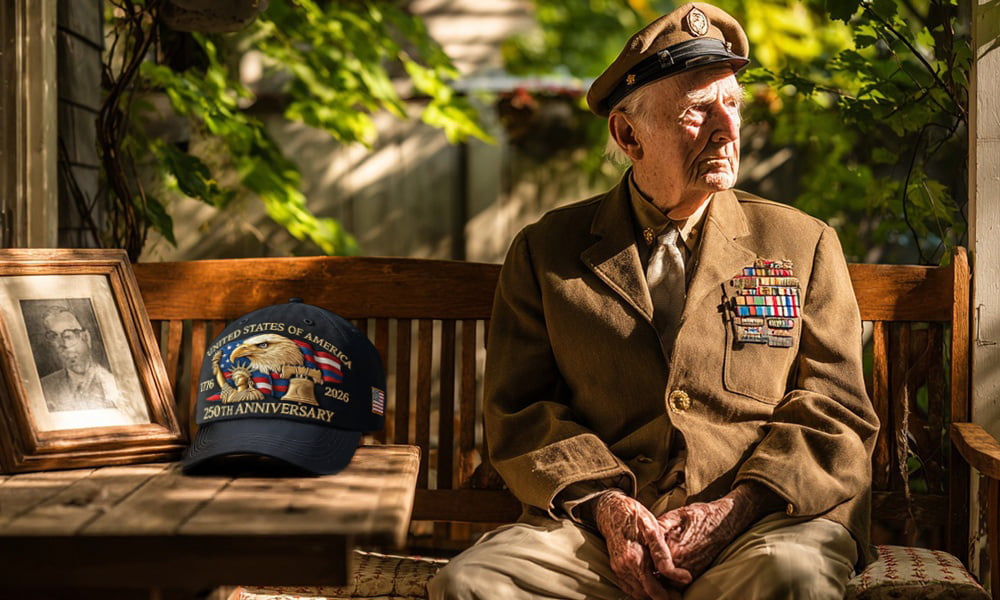
Lancaster County, May. Someone raises a glass at Thanksgiving. It is the grandchildren’s idea, the way it always is. They have learned enough in school this year to understand that what their grandfather did was large. They want to say so. They stand and look at him across the table and begin.
He shakes his head before they finish the sentence. “I just did my job,” he says. He means it. He has meant it every time for forty years. The table settles. Someone passes the rolls. And the thing the grandchildren wanted to say goes back to wherever it lives between holidays.
Tom Calder knows that table. He sat at one like it for years before he understood what the deflection costs.
Above his stitching machine, he keeps a pair of canvas work gloves from his last month in the Army motor pool. The leather is so stiff now it would split if he tried to use them. He bought new gloves twice in thirty years. Both times he put the new pair somewhere else and kept reaching for the old ones out of habit, until he understood that the habit was not about the gloves.
The thank-you never went anywhere. It just stopped being said.
Most veterans are not modest. They are trained. Four decades of “I just did my job” is not self-deprecation. It is a reflex built from years of watching men who did more stand quietly beside men who did less. It is the math of service. You measure yourself against what was asked, not against what the family knows.
The family knows something different. They watched him come home. They watched what came back with him and what didn’t. They have watched forty years of Tuesday mornings, and they know exactly what his job was.
What they cannot give him is a stranger’s nod in a hardware store parking lot. Recognition from the people who love you is different from recognition from someone who has no reason to give it. The second kind is the one that tends to land differently. It is the one most veterans almost never receive, because nothing they wear on an ordinary Tuesday tells that story.
Tom built the cap for that Tuesday.
Six Years in the Motor Pool. Three Decades Learning What People Do to Things That Matter.
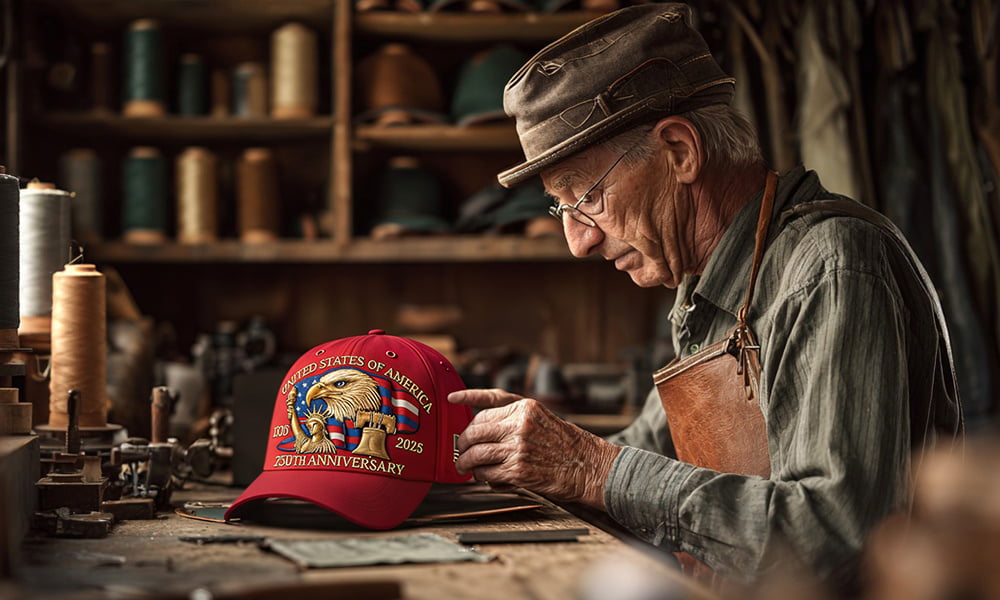
Thomas Calder spent six years as an Army mechanic, then opened a repair shop outside Lancaster that fixed the things people needed to last. Canvas covers. Work jackets. Equipment bags. Uniform seams. For thirty years, he saw what people held onto longest and worked hardest. They wore it until the stitching gave. They brought it in three times before they would let it go. He understood early that durability was not a selling point. It was a moral position.
He still measures twice with a paper ruler taped to the table. He still prints every order Erin sends him because he does not fully trust what he cannot hold. His daughter finds this funny. He lets her find it funny.
The shop is not decorated. Finished caps sit on a pine shelf in five colors: Deep Navy, Army Green, Bold Red, Black, and Khaki. A framed photograph of Tom in fatigues leans against the wall behind the sweatband box. He put it there when he ran out of clear shelf space in 2023. He has not moved it since, which means he has decided.
“I spent thirty years fixing things people brought back three times before they could let go. That is the standard I build to. Not the first wear. The hundredth.”
The Man in the VFW Parking Lot Who Did Not Shake Tom’s Hand
In January 2025, Tom wore an early sample to a VFW meeting outside Lancaster. He had not thought about it. He grabbed a cap on the way out the same way he always does and drove over. After the meeting, in the parking lot under the overhead light, a man he did not recognize stopped beside his truck.
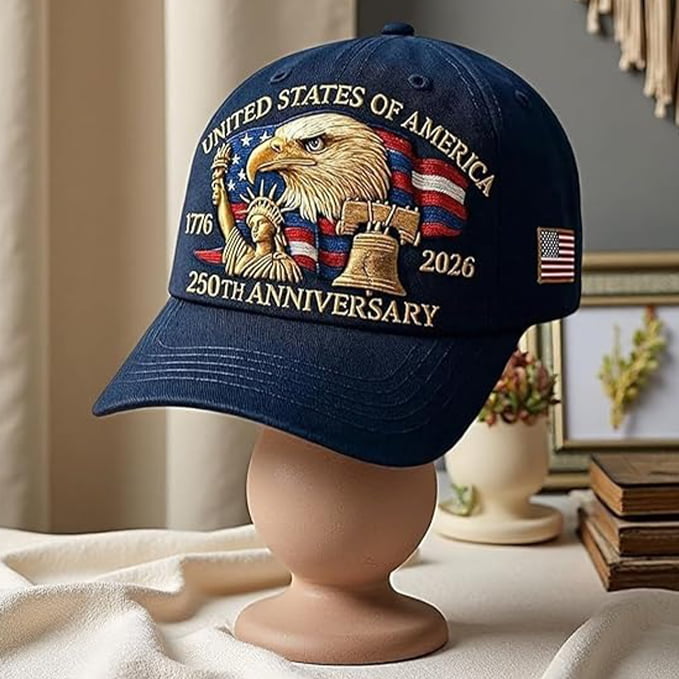
The man was in his eighties. He looked at the front panel of Tom’s cap for a moment, at the dates 1776 and 2026, at the eagle, at the Bell. He did not introduce himself. He did not shake Tom’s hand. He pointed at the cap once with two fingers and said one word.
“Korea.”
Tom said yes, he had made the cap himself, in his shop. The man looked at the panel again. Then he walked to his car. Tom sat in his truck for a while before he started the engine. He drove home and called Erin at nine o’clock, which he almost never does that late. He told her he thought the cap was ready.
The Four Details That Make It Something He Will Actually Wear

Frank Wore It to the VA Pharmacy on a Tuesday. His Wife Counted the Ceiling Tiles.
Eleanor Marsh of Pittsburgh ordered a cap for her husband Frank in November 2024. Frank is eighty-one. He served in Korea and has discussed it with Eleanor once in fifty-three years of marriage, briefly, when their eldest son asked a direct question at the kitchen table in 1987. Frank answered, then asked someone to pass the butter, and that was the end of it.
Eleanor ordered the Deep Navy. She wrapped it herself and left it by his coffee cup on Veterans Day morning. Frank looked at it for a moment before he picked it up. He read the dates with his thumb, the same way Eleanor has watched him read things that matter to him since 1971.
The following Tuesday, he wore it to the VA pharmacy. A younger veteran in line looked at the front panel, then at Frank. He said: “Korean?” Frank said yes. They talked for eleven minutes. Eleanor knows because she had nothing else to do in that waiting room and counted the ceiling tiles in the hallway while she waited, and then asked Frank how long they had talked when he came out.
Fifty-three years. Eleven minutes. One cap. One Tuesday.
What Families Are Saying
Wednesday, 6:03 A.M.
Tom was checking the Liberty Bell’s registration on a finished panel when he realized he could not read the detail clearly enough to pass it. He held the cap at arm’s length. Still soft. He looked for his reading glasses, which he has needed for patch work since last fall and misplaces twice a day. He found them in the coffee can with the dull needles, where they had been sitting since Tuesday.
He checked the panel again. It passed. He set the glasses back in the coffee can because that is where he will look for them next, and moved to the next cap.
The batch runs until the blanks are gone or until July comes, whichever arrives first. Some panels pucker at the crown curve. Some patches sit one stitch too high. Those go into the reject box beside the door, which Erin empties on Fridays. The anniversary does not pause for the reject box. Tom does not ship from it.
“July 4th is one date. If the cap is not right before that morning, it does not matter how fast it ships.”
“It Was Never About the Money”
Tom says it while folding a finished cap into its box. He does not slow down to make the sentence sound important. “It was never about the money.” He tucks the flap, sets the box on Erin’s stack, and picks up the next blank. Then he says the rest of it.
“I want these caps on porch hooks. On truck seats. On the hook by the back door that means a thing leaves the house. Not behind glass. Not on a shelf above the flag case. Somewhere it goes out into the world on an ordinary morning and a stranger sees it and does the thing nobody at the dinner table knew how to do.”
Ten percent of what comes in goes to veteran organizations. Not the ceremonial kind. The kind that answer the phone at eleven at night. Tom wrote that into the business from the beginning and has not discussed it since because he does not consider it a decision that requires ongoing discussion.
One Ordinary Morning Where His Service Is Visible Without Being Explained
Forty years of “I just did my job.” One cap that does not agree.He will not stop saying it. That is not what this is for. This is for the mornings after he says it, when he walks out the front door wearing something that tells the story to anyone standing close enough to read it. A nod from a stranger at the gas station. A handshake at the diner counter. A man in a VA waiting room who says one word and starts eleven minutes neither of them planned.
Tomorrow morning, you could set it on the kitchen table before he comes downstairs, pour his coffee, and let him find it. Watch what he does with his hands before he says anything. That will tell you whether you got it right.
30-Day Satisfaction Guarantee
Let him wear it. To the diner, the hardware store, the parade, or just the back porch on a quiet morning. If it does not feel like the right tribute, send it back.
Tom spent thirty years fixing things people could not let go of. He builds to the same standard he fixed to. The guarantee works the same way.
The 250th Anniversary Patriot Cap is a handcrafted adjustable snapback with patriotic embroidery, a side U.S. flag patch, and a reinforced sweatband. Natural variation may occur in small-batch finishing. Free shipping. Delivered in 5–8 business days. This is a sponsored post.